


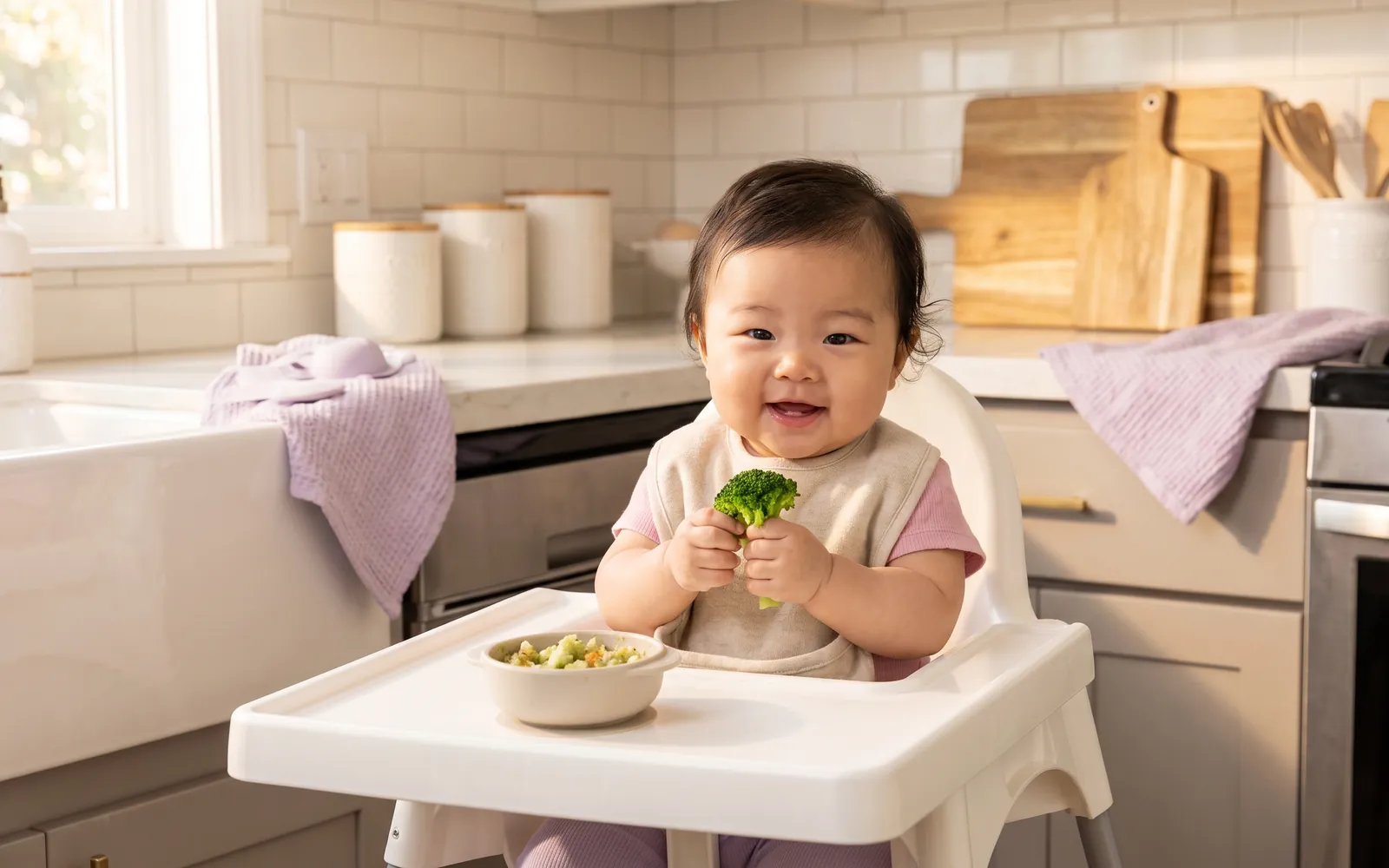
The first spoonful rarely goes where you planned. Some babies look offended, some grab the spoon, some open wide like a baby bird and then push everything straight back out with their tongue. All of it is part of learning to eat, and all of it is worth remembering.
This guide walks through the practical side of starting solids, from readiness signs and safe sizes to allergens and honey, and then shows how to keep a small, gentle photo diary of first tastes. It is general information, not medical advice: every baby is different, so talk to your paediatrician before and during this stage.
Is your baby ready? Signs to look for
Most guidance, including the WHO, the NHS and the AAP, suggests starting solid foods at around 6 months. Age is only half of it. Look for these signs together:
- Steady head and neck. Your baby can hold their head up well and sit upright with some support.
- Hand to mouth. They can look at food, pick it up and bring it to their mouth on their own.
- Swallowing, not pushing out. When food goes in, more of it is swallowed than pushed back out by the tongue.
- Interest. Watching your plate closely or reaching for your food can be a hint, though on its own it is not a reliable sign.
Waking more at night or chewing fists are common at this age and are not, by themselves, signs of readiness. If your baby was born early, or if you are thinking about starting before 6 months, discuss the timing with your paediatrician.
Setting up a safe seat and a calm table
Where your baby eats matters as much as what they eat.
- Upright in a high chair. Your baby should sit straight, facing forward, with the harness done up. Never offer food in a bouncer, a car seat, lying back or while crawling around.
- Feet supported if possible. A footrest helps many babies sit steadily and focus on chewing.
- You stay right there. Sit with your baby for the whole meal. Leaving the room for "just a second" is the one habit to avoid.
- Calm, not rushed. Pick a time when your baby is not tired or very hungry. Offer milk as usual; in the first year breast milk or formula is still the main source of nutrition.
- Water with meals. From around 6 months you can offer small sips of water from an open or free flow cup.
First textures and sizes
There are two common approaches: spoon feeding smooth or mashed foods, and baby led weaning with soft finger foods. Many families mix both. Either way, a good rule for early finger foods is the squash test: the food should squash easily between your thumb and forefinger.
| Food | A safer way to start | Avoid at this stage |
|---|---|---|
| Banana | Mashed, or a thick finger length piece | Hard, unripe chunks |
| Avocado | Mashed, or wide soft slices | Firm, unripe slices |
| Carrot, sweet potato | Steamed until soft, as sticks or mashed | Raw sticks and hard rounds |
| Apple, pear | Cooked until soft, or finely grated | Raw slices and chunks |
| Grapes, blueberries, cherry tomatoes | Quartered lengthways or flattened | Whole |
| Egg | Well cooked, as omelette strips or mashed | Large lumps of dry yolk |
| Peanut | Smooth peanut butter stirred thinly into porridge or yogurt | Whole or chopped nuts, thick blobs of nut butter |
| Fish, chicken | Soft, shredded or flaked, bones removed | Hard chunks, sausages cut into rounds |
| Toast | Lightly toasted fingers | Big pieces of soft bread that form a sticky ball |
Finger foods about the size of an adult finger are easier for a 6 month old to hold, since babies grip with their whole hand before they can pinch small pieces. Textures move on over the following months towards lumpier mashes and smaller soft pieces. Your paediatrician can guide the pace.
Choking hazards and gagging
Gagging and choking are not the same thing, and knowing the difference makes mealtimes much less frightening.
- Gagging is loud and messy: coughing, spluttering, watery eyes, food pushed forward. It is a normal reflex while your baby learns to move food around. Stay calm and let them work it out.
- Choking is often silent. A baby who cannot cough, cry or breathe, or who is turning blue, needs help immediately.
Doing a baby first aid course before starting solids is one of the most useful hours you can spend. Common choking hazards to prepare carefully or avoid:
- Whole grapes, cherry tomatoes, blueberries, olives and similar small round foods (quarter or flatten them, and choose pitted olives)
- Whole nuts and seeds (whole nuts are not recommended for young children at all)
- Popcorn, hard sweets, marshmallows
- Raw hard vegetables and hard fruit
- Sausages and hot dogs in rounds (cut lengthways into thin strips)
- Chunks of hard cheese (grate it instead)
Allergens, honey and other things to hold off
Allergens
Common food allergens include egg, peanut, cow's milk, wheat, soy, sesame, tree nuts, fish and shellfish. Current advice in many countries is not to delay them, and to offer them from around 6 months, one at a time:
- Offer a small amount of one new allergen, in a safe texture, earlier in the day.
- Watch your baby for the next few hours.
- If all is well, keep offering it regularly.
- Wait a couple of days before the next new allergen, so you can tell what caused any reaction.
If your baby has severe eczema, an existing food allergy or a close family history of allergies, talk to your paediatrician before introducing allergens. Swelling of the face or lips, difficulty breathing, or sudden floppiness needs emergency help.
Honey
No honey before 12 months, not even a little taste on a dummy. It can contain bacteria that cause infant botulism.
Also worth holding off
- Added salt and sugar. Babies do not need them; skip stock cubes, salty cheeses in large amounts, and sweetened snacks.
- Cow's milk as a main drink. Fine in cooking and in foods like yogurt from around 6 months, but not as a drink before 12 months.
- Tea, coffee and sugary drinks. Not suitable for babies.
Guidance differs a little between countries and changes over time, so treat this as a starting point for the conversation with your paediatrician.
A gentle first month
There is no single right plan, but many families find a rhythm like this manageable:
- Week one: one meal a day, a few tastes of a single vegetable or fruit. Focus on the experience, not the amount.
- Week two: try new vegetables, including less sweet ones like broccoli or courgette.
- Week three: start introducing allergens one at a time, and move up to two meals a day if your baby is keen.
- Week four: combine foods they already know, and let them explore more textures and finger foods.
Some days your baby will eat almost nothing. That is expected at this stage, when milk still does most of the work.
Your first foods photo diary
The first months of solids are one of the most expressive stages you will ever photograph. Every new flavour gets a new face. A small diary, kept up with a few photos a week, becomes a sweet record of how your baby discovered food.
Set the scene before food arrives
Move the high chair near a window so soft daylight falls from the side. Clear the wall behind if you can. Put your phone where you can reach it without leaving your baby, but out of their reach. Once food is on the tray, your hands and eyes belong to your baby, so all setup happens first.
Photo ideas
- The first taste face. Record a short video of the very first spoon. The scrunched nose is often better in motion than in a still.
- From the side, at eye level. Shoot from about a metre away, level with the tray, so you are not blocking the spoon or the view.
- Hands and mess. Once the meal is over, before the wipe down, capture the avocado fingerprints on the tray.
- The first tastes card. Keep a card on the fridge listing each new food with its date. Photograph it at the end of every month.
- Same chair, same spot. Take one photo in the high chair from the same place every month. Over a year you watch a tiny baby grow into a confident toddler. Our monthly baby milestone photo ideas show how to keep a series like this consistent.
- At the family table. A wide shot of your baby joining a real family meal, plates and all.
A few rules for safe photos
- Never pause your baby mid mouthful for a pose, and never ask them to look up while they are chewing.
- Do not add extra food to their face or hands for a messier photo.
- If you are the one feeding, let another adult take the photos, or keep it to before and after shots.
For technical help with low indoor light and moving hands, our guide to taking baby photos with iPhone covers focus, exposure and burst mode.
Keeping the story
A year from now, the first spoon of sweet potato will feel like a long time ago. If you keep your food diary alongside a daily or weekly photo, you can see both stories together: the growing baby and the growing appetite. Our overview of baby milestones month by month is a helpful companion for what else tends to change in the same months.
Some parents also like to turn a favourite high chair photo into a small keepsake. The AI keepsake cards in TinyLapse include a Kitchen morning preset, which starts from one photo you choose, and more ideas are in our article on AI baby keepsake card ideas. You can find TinyLapse on the App Store.
Small moments pass quickly, their story stays. The mashed banana on the ceiling will be cleaned up by tonight, but the photo of the proud, sticky face can stay with you for good.