
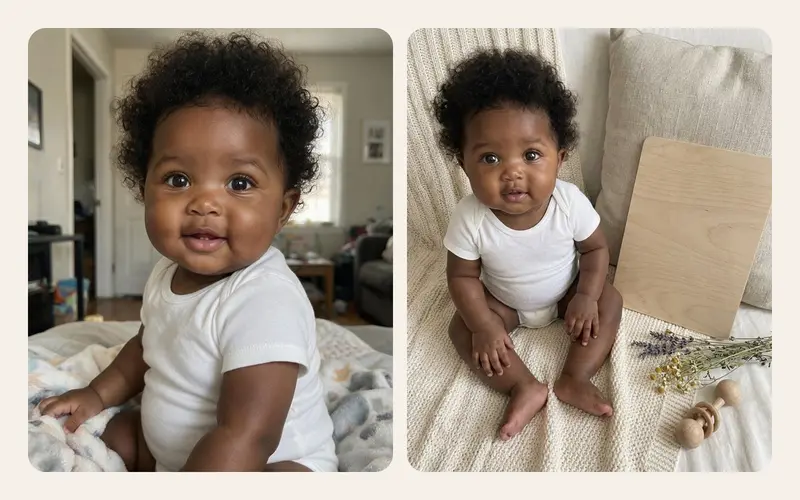

At six in the evening, the house can feel like it is speeding up just as everyone wants it to slow down. Dinner, washing up, a baby rubbing their eyes, an older child who suddenly has energy to burn. A bedtime routine will not solve every night, but it gives the evening a shape, and babies love a shape.
This guide covers why a routine helps, a simple sequence that many families use, the safe sleep basics from the AAP and NHS, how the routine changes over the first three years, and how to photograph your sleeping baby in a way that never changes how they sleep. Sleep is personal and every baby is different, so if you have concerns, talk to your paediatrician.
Why a routine helps
Babies cannot read a clock, but they notice patterns. When the same few things happen in the same order each evening, the steps become cues: warm water means pyjamas, pyjamas mean a feed, the song means the cot. Over weeks, those cues help many babies wind down more easily.
A routine helps parents too. It turns bedtime into a series of small, known tasks, which is much easier to manage at the end of a long day, and much easier to hand over to a partner, a grandparent or a babysitter.
Two honest caveats. First, a routine does not guarantee sleep; teething, growth spurts and illness will still bring rough nights. Second, very young babies sleep when they need to, and for the first weeks a gentle evening mood matters more than a strict schedule.
A simple routine many families use
Keep it short, calm and repeatable. Here is one sequence, and you can reorder it to suit your home:
- Dim the lights. About half an hour before bed, lower the lights in the rooms you use and switch off the television.
- Bath or a warm wash. A bath a few evenings a week, or a warm washcloth on other nights. Our baby bath time guide covers how to keep it safe.
- Nappy and pyjamas. In the room where your baby sleeps, with soft light.
- Feed. Many babies feed as part of the routine. For older babies, some families move the feed earlier, before the book, so feeding and falling asleep are not always linked.
- A book or a song. The same song every night becomes a powerful cue. Short board books work well from a few months old.
- Into the cot, on the back. Many parents try laying their baby down drowsy but awake, though plenty of young babies fall asleep feeding, and that is fine.
- Lights out, a quiet goodnight. A short phrase you always use, such as "Sleep well, see you in the morning."
Try to start around the same time each evening. Consistency does more than any single step.
Safe sleep basics from the AAP and NHS
Whatever your routine looks like, these apply to every sleep, day and night:
- On the back, every time. Place your baby on their back to sleep, for naps and at night.
- Firm and flat. A firm, flat mattress in a cot, crib or moses basket that meets current safety standards, with a fitted sheet.
- Nothing loose in the cot. No pillows, bumpers, duvets, loose blankets, soft toys or positioners. An empty cot is a safe cot.
- Same room as you. Both the AAP and the NHS recommend room sharing, with your baby in their own sleep space, for at least the first six months.
- Not on a sofa or armchair. Never fall asleep with your baby on a sofa or armchair. If you feel sleepy while feeding, move your baby to their cot.
- Not too warm. Dress your baby for the room, without hats indoors. The NHS suggests a room temperature of 16 to 20°C.
- Sitting devices are not for sleep. If your baby falls asleep in a car seat, swing or bouncer, move them to a flat, firm surface when you can.
- Smoke free. Keep your baby's environment free of smoke, before and after birth.
If you use a baby sleeping bag, choose the right size and tog for the room. If you swaddle, stop as soon as your baby shows signs of trying to roll, and ask your paediatrician about it.
How the routine changes as your baby grows
Every child moves at their own pace, so treat this as a loose outline.
| Age, roughly | What bedtime can look like |
|---|---|
| 0 to 8 weeks | No fixed routine yet. Dim the lights in the evening and keep night feeds quiet and dark. |
| 2 to 4 months | A short routine of wash, pyjamas, feed and song, then into the cot on the back. |
| 4 to 12 months | A more consistent time, a book added in, and practice lying down drowsy but awake. |
| 1 to 3 years | Tooth brushing, one or two books, small choices like which pyjamas, and a clear goodnight. |
Toddlers often test bedtime, asking for one more book or one more drink. Offering small choices within the routine ("the rabbit book or the moon book?") tends to work better than debating whether bedtime is happening. For a sense of what else changes in these years, see our guide to toddler milestones from 12 to 36 months.
Sleeping baby photos, the safe way
A sleeping baby is one of the most photographed sights in any family. The golden rule: the photo takes your baby exactly as they are. Nothing about their sleep position or their sleep space changes for a picture.
What to do
- Flash off. Tap the flash icon and choose Off. A flash can wake and startle your baby, and it flattens soft evening light anyway.
- Use the light that is already there. A night light, a lamp in the hallway, or the last daylight through the curtains. On recent iPhones, Night mode turns on by itself in low light; hold still or brace your arms on the doorframe for the few seconds it needs.
- Go quiet. Switch the phone to silent, which mutes the shutter sound in most countries.
- Shoot from the side of the cot. Stand beside the cot and photograph through or over the rail, without leaning on it or reaching in.
- Focus on details. Eyelashes, a hand thrown above the head, the pattern of the sleeping bag. Details often say more than a full frame.
What not to do
- Do not reposition your baby. Not the arms, not the head, not the blanket. If the angle is not quite right, change where you stand, not your baby.
- Do not add anything to the cot. No teddy bears, blankets, pillows or letter boards for a nicer shot, not even for a moment.
- Never put the phone in the cot.
- Do not stage sleep photos in unsafe places, such as on a sofa, an adult bed, or propped on cushions.
- Stop if your baby stirs. Sleep is worth more than the photo.
Posed sleepy newborn photos you see online are often made by trained professionals, sometimes as composites. At home, the safest approach is simply to photograph real sleep. Our article on safe newborn poses at home explains which poses to leave to professionals, and the guide to taking baby photos with iPhone has more tips for low light.
Photographing the routine, not only the sleep
Some of the loveliest bedtime photos do not show sleep at all. They show the ritual:
- The folded pyjamas and the favourite book waiting on the chair
- Your partner's hand turning the page, with your baby's hand reaching for it
- A sibling reading to the baby on the floor before bed
- The lamp that means goodnight, photographed in the same spot every few months
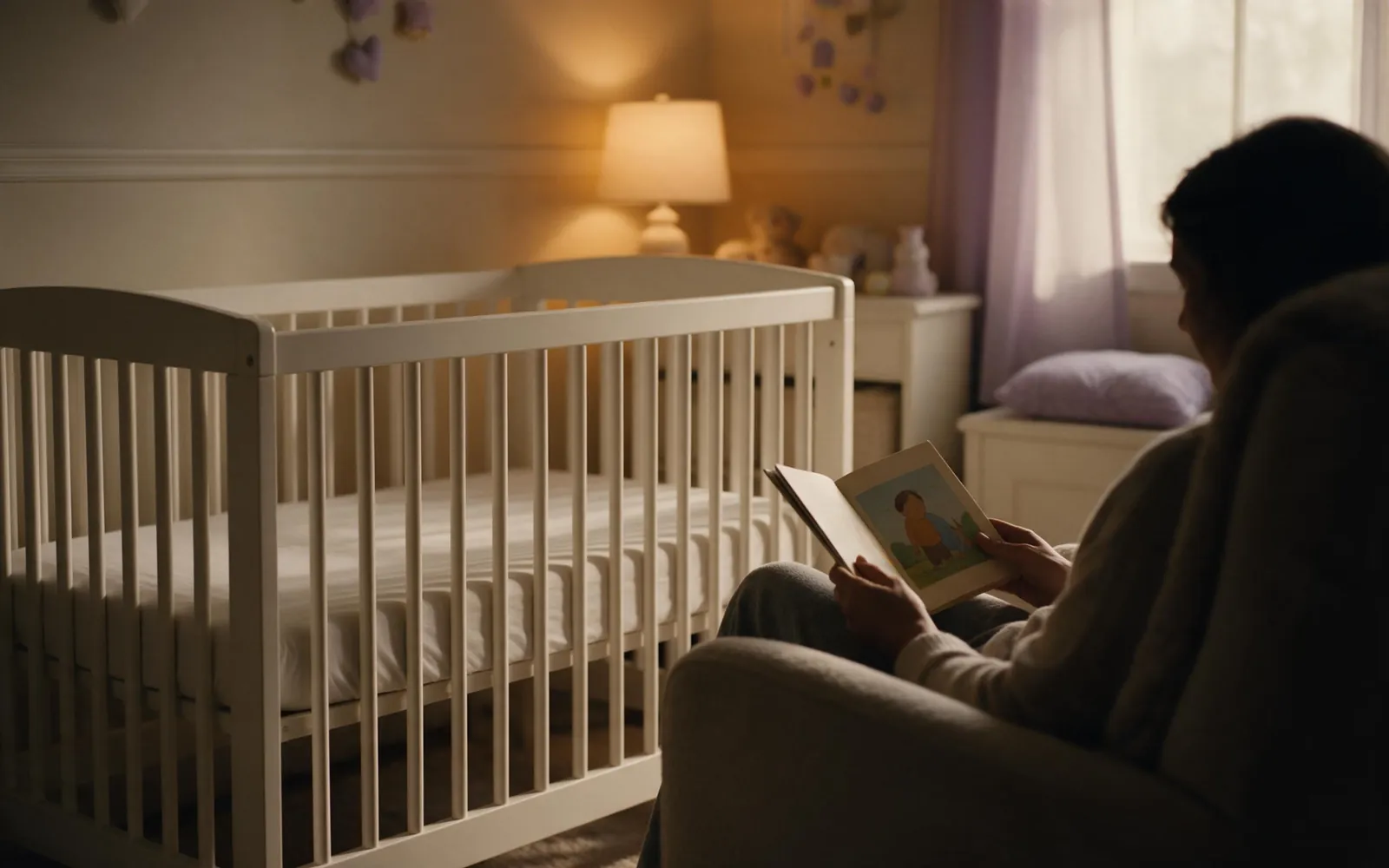
- A wide shot of the cot from the doorway, empty and ready, the night before your baby moves to a bigger bed
The Guide tab in TinyLapse includes a skill card on photographing sleeping babies, alongside month by month cards for the first three years; you can read about it in the guide section of our home page. If a gentle evening photo habit sounds good to you, TinyLapse is on the App Store.
Small moments pass quickly, their story stays. The same song, the same book, the same soft lamp, night after night: years from now, a few quiet photos of those evenings will hold the feeling of them better than any memory can.