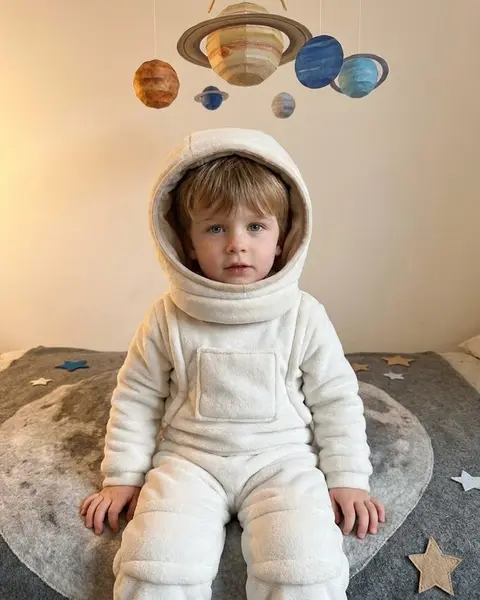
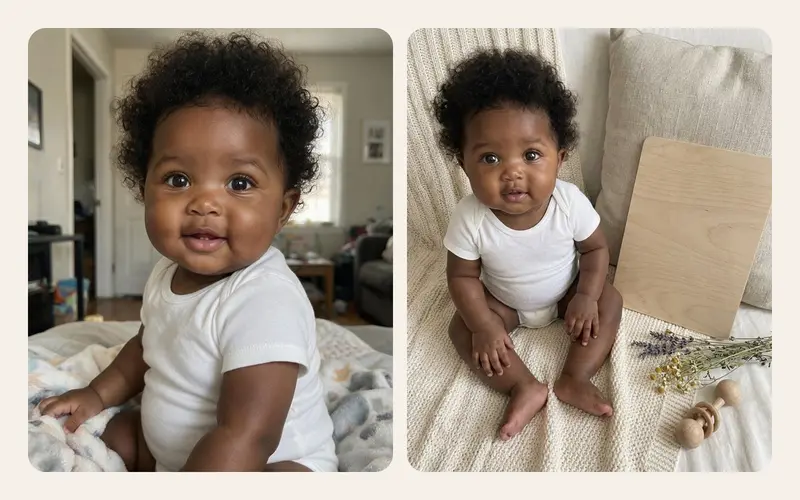

On paper, the second and third years look calmer than the first. There is no leap from curled-up newborn to crawler. Then you put the first birthday photo next to one from the third, and the baby has simply gone: longer legs, a different face, and firm opinions about which T-shirt appears in the picture.
This guide covers toddler milestones from 12 to 36 months in four stages, drawing on the CDC's "Learn the Signs. Act Early." checklists, the WHO study on walking, and guidance from the American Academy of Pediatrics and the NHS. Each stage comes with a photo idea that works with a child who will not sit still. As with any milestone list, these are typical ranges, not targets. Every child develops at their own pace, and your paediatrician is the right person for questions about your child.
Why toddler development looks uneven
If the first year felt like a steady climb, the next two can feel like stairs. A few reasons:
- Skills arrive in bursts. Many parents notice that a toddler who is busy mastering walking or climbing seems to pause on new words for a while, then catches up with a rush of them.
- Checklists describe most children. Each item on the CDC's checklists is something 75% or more of children do by that age, so plenty of healthy toddlers are still working on one or two.
- Temperament plays a part. Cautious toddlers often watch a skill for weeks, then do it properly on the first try. Bolder ones practise loudly and fall over a lot.
- Two languages change the count. Children growing up with two languages may mix them or know some words in only one. Counting words across both languages gives a fairer picture.
12 to 18 months: first steps and first words
By about 15 months, the CDC checklist includes taking a few steps alone, feeding with the fingers, trying to say one or two words besides "mama" or "dada", pointing to ask for something, and stacking at least two small objects.
By about 18 months, it includes:
- walking without holding on to anything
- climbing on and off a sofa or chair without help
- trying to say three or more words besides "mama" or "dada"
- following a one-step instruction without a gesture, like "give me the cup"
- trying to use a spoon
- pointing to show you something interesting
Walking has a particularly wide window. In the WHO study, healthy children started walking alone between 8.2 and 17.6 months. If you want a refresher on how those windows work, our guide to baby milestones month by month explains them in more detail.
Photo idea: walking towards you
Kneel at the far end of a hallway with the phone at your toddler's eye level, not yours. Call their name and take a burst of frames as they come towards you. The best frame is usually the one with a foot in the air and arms out for balance. Take the same shot each month in the same hallway and you have a small film of walking getting steadier.
18 to 24 months: running, climbing and two-word phrases
By about 24 months, the CDC checklist includes:
- kicking a ball
- running
- walking up a few stairs, with or without help
- eating with a spoon
- saying at least two words together, like "more milk"
- pointing to at least two body parts when asked
- noticing when someone is hurt or upset
- playing with more than one toy at the same time
This is often the stage of "no", of carrying one particular object everywhere, and of wanting to press every button in the lift. It is also when proportions start to change: the rounded baby tummy flattens and legs get longer.
Photo idea: the door frame
Pick one door frame and photograph your toddler standing beside it, full body, feet flat on the floor, once a month. Hold the phone at about half their height and step back far enough that you can see a little floor and a little space above their head. The door frame stays exactly the same size, so growth is easy to read. Our article on the same angle every time explains why a fixed reference matters so much.
24 to 30 months: jumping, pretend play and "I can do it"
By about 30 months, the CDC checklist includes:
- jumping off the ground with both feet
- taking off some clothes, like loose trousers or an open jacket
- turning book pages one at a time
- saying about 50 words
- using words like "I", "me" and "we"
- simple pretend play, like feeding a toy
- following two-step instructions, like "put the toy down and close the door"
Pretend play is one of the loveliest things to watch. A two-year-old serving invisible soup to a teddy is practising language, planning and empathy all at once.
Photo idea: the pretend game, from the side
Do not interrupt it. Sit at their height, a metre or so to one side, and photograph the game as it happens. Window light from the side, a plain floor and no request to look at the camera. These photos age better than any posed smile, because they show who your child was at that moment, not how they reacted to a phone.
30 to 36 months: questions, friends and real conversations
By about 36 months, the CDC checklist includes:
- talking with you in a conversation of at least two back-and-forth exchanges
- asking "who", "what", "where" or "why" questions
- saying their first name when asked
- being understood by others most of the time
- drawing a circle after you show them how
- joining other children to play
- putting on some clothes, like loose trousers or a jacket
- using a fork
Three-year-olds usually want a say in the photo. That is a feature, not a problem.
Photo idea: their pose, then yours
Let them choose the first frame: a silly face, a superhero stance, a favourite toy held up to the lens. Then take your usual monthly frame in the usual spot. You get the personality shot and the consistent one, and your child learns that photos are something they take part in.
A quick summary table
| Age | Movement | Language | Play and independence |
|---|---|---|---|
| 15 months | a few steps alone | 1 or 2 words besides mama or dada | stacks 2 small objects |
| 18 months | walks without holding on | tries 3 or more words | tries a spoon |
| 24 months | runs, kicks a ball | 2 words together | notices when others are upset |
| 30 months | jumps with both feet | about 50 words, uses I and me | simple pretend play |
| 36 months | uses a fork, puts on some clothes | short conversations, asks why | joins other children to play |
When to talk to your paediatrician
The CDC's advice applies at every age: if you have a concern, act early and ask. Reasons parents often raise with their paediatrician include:
- Your child is not walking by 18 months, which the NHS names as a reason to talk to a health visitor or doctor.
- Your child loses words or skills they used to have.
- Several items on the checklist for their age are missing.
- You wonder whether your child hears well, or others find their speech very hard to follow near age three.
- Your child rarely points, shows you things or looks where you point.
The AAP recommends general developmental screening at the 18 and 30 month visits and autism screening at 18 and 24 months, so the questions have a natural place. Write down what you notice in your phone's notes with the date, and bring a short video if it helps. Only a professional who can see your child can interpret a pattern; a milestone list, this article included, cannot.
Photographing a toddler who will not sit still
Toddlers are the hardest subjects in family photography and also the most rewarding. A few habits help:
- Photograph the activity, not the pose. Stacking, pouring, climbing. The hands are busy, so the face relaxes.
- Drop to their height. Photos taken from adult height make toddlers look small and far away.
- Use burst mode and pick later. A second of movement contains one good frame.
- Give a job, not a command. "Can you knock on the door?" works better than "stand still".
- Keep the light the same. Morning window light in the same room makes months easy to compare.
- Step back rather than zooming in close. A little distance keeps faces natural, and our tips on taking baby photos with an iPhone cover lens choice and focus.
The monthly Guide cards run all the way to 36 months, with a shot idea for each month, so you do not have to invent a new setup every time.
A two-year photo rhythm that fits real life
Between the first and third birthdays, once a month is plenty. Aim for a few days either side of the monthly birthday rather than the exact date, keep the same spot and the same door frame, and add a wider photo each season: the first snow, a summer park, the first day at nursery.
Before posting any of these online, it is worth thinking about how your child might feel about them later; our guide to sharing kids' photos online has practical rules of thumb. Most monthly frames are for the family, and they make a quietly powerful time-lapse video when your child turns three. If you would like reminders and the child's age on each photo, you can find TinyLapse on the App Store.